
Introduction: A Turning Point Reverberating Around the World
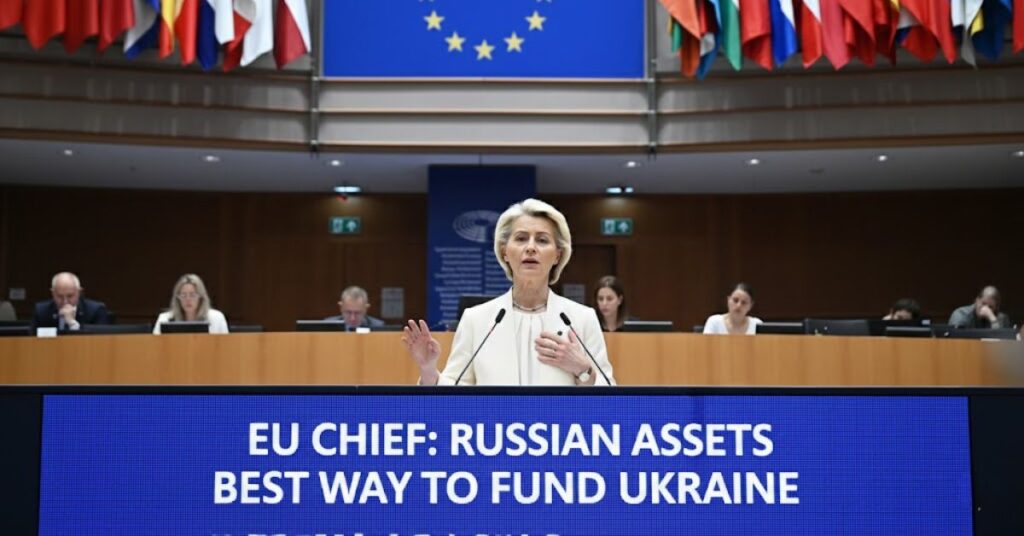
Russian Assets to Fund Ukraine – In a move catching headlines across all major USA news outlets, the European Union finds itself at a historic crossroads. The EU Commission’s top leader has thrown her full weight behind a controversial but urgent proposal: using seized Russian Assets to Fund Ukraine’s desperate recovery efforts. This is not just another out-of-touch bureaucratic suggestion but a call that’s echoing in parliaments, boardrooms, and coffee shops around the globe. Is this the bold action Ukraine needs? Or a diplomatic firestorm in the making? Strap in, because the debate around Russian Assets to Fund Ukraine has America, Europe, and Russia asking tough questions about law, morality, and the future of the world order.
The Context: Why “Russian Assets to Fund Ukraine” Became the Global Headline
Even before Russian tanks rolled over the Ukrainian border, tensions between Moscow and the West simmered with post-Cold War distrust. The invasion shocked the world, and in response, Western nations imposed sweeping sanctions, freezing hundreds of billions in Russian state and oligarch assets. That money—once untouchable—became the focus of new hope and, inevitably, controversy.
Now, as the conflict drags on longer than many dared expect, Ukraine’s needs are greater and more urgent. The idea of repurposing Russian Assets to Fund Ukraine’s reconstruction isn’t just financial; it’s symbolic. It’s justice, say some, and illegal expropriation, say others.
Here’s what’s at stake:
| Who’s Involved | What’s at Stake | Potential Impact |
|---|---|---|
| EU Leaders | Billions in frozen Russian assets | A possible financial lifeline |
| Ukraine | Funding to rebuild destroyed infrastructure | Accelerated road to recovery |
| Russia | Loss of major foreign-held reserves | Retaliatory measures, legal action |
| Global Economy | Principles of property, sanctions enforcement | Trust in Western legal systems |
The Proposal: What Does “Using Russian Assets to Fund Ukraine” Mean?
At the core, the EU Chief’s plan is simple: assets belonging to Russia—whether from its central bank, state-owned companies, or sanctioned oligarchs—wouldn’t just sit frozen. Instead, they’d be put to work, directly channeled into Ukraine’s reconstruction budget. Every Euro or Dollar harvested from Russian holdings becomes cement, steel, power lines, and medicine for Ukraine’s battered people.
But nothing is as simple as it sounds. There isn’t a global legal playbook for converting Russian Assets to Fund Ukraine, especially not assets of a recognized sovereign nation and private citizens held overseas. The plan divides into two main paths:
- Government Assets: Considered easier to seize and repurpose, especially if held in central bank reserves.
- Private Assets: More complicated, with many legal and human rights challenges, as Western courts wrestle with the difference between government actions and private ownership.
Every day this proposal is on the table, it’s not just about dollars and sense. It’s a tug-of-war between justice, legal precedent, and the question dominating the USA news cycle: can this become the new normal in global conflicts?
Human Impact: How “Russian Assets to Fund Ukraine” Resonates Beyond the Numbers
Beyond treaties and balance sheets, the plan touches ordinary lives on every side.
- In Ukraine’s cities, hope flickers that bombed-out schools and homes might finally be rebuilt.
- Across Russia, fears loom that citizens’ savings or legitimate investments abroad could vanish overnight.
- In European capitals from Berlin to Warsaw, taxpayers hope this move relieves their own financial burden to help Ukraine.
- In the USA, lawmakers and citizens are keenly watching: if Russian Assets to Fund Ukraine succeeds, could seized assets fund future American-led recoveries elsewhere?
The faces are real: Ukrainian mothers dreaming of new apartments, European businesses torn between contracts and conscience, Russian students abroad suddenly unable to access funds for tuition. With each debate, “Russian Assets to Fund Ukraine” shifts from abstraction to extraordinary, deeply personal importance.
Legal Labyrinth: Can The West Really Use Russian Assets to Fund Ukraine?
No EU Chief in modern history has pushed for something quite so bold. The legal thicket is dense, even for seasoned experts.
Under international law, countries have long frozen assets in times of war or sanction—but outright confiscation is another matter. Seizing Russian Assets to Fund Ukraine risks major diplomatic fallout and lawsuits in nearly every court that touches the money.
The main legal hurdles:

- Sovereign Immunity: Traditionally, a nation’s funds held abroad are off-limits.
- Due Process and Property Rights: Especially for private citizens and companies.
- International Precedent: Such a move could boomerang, putting Western assets at risk in other conflicts.
Yet, supporters argue: what’s the point of freezing assets if not to neutralize the machinery of war? With new legal frameworks emerging almost daily, this moment is testing old precedents like never before.
Comparative Table: The Scale of Russian Assets Frozen in the West
| Country/Region | Estimated Assets Frozen (USD) | Comments |
|---|---|---|
| European Union | $270 billion | Includes central bank |
| United States | $78 billion | Oligarch/property mix |
| United Kingdom | $28 billion | Private/state |
| Canada & Allies | $23 billion | Varied sources |
| Total | Nearly $400 billion | Massive leverage |
That’s a war chest equal to the entire annual economy of some small countries—now caught in the crosshairs of justice and geopolitics.
Economic Stakes and Ripple Effects of Using Russian Assets to Aid Ukraine
As the Russian Assets to Fund Ukraine pitch spreads, economists are running the numbers. Even a small portion of the seized funds could radically change Ukraine’s future, with knock-on effects worldwide. What happens if the EU—and potentially other G7 nations—turns this into reality?
For Ukraine:
It’s transformational. Suddenly, battered cities and shattered infrastructure could see an infusion of funds not seen since the Marshall Plan. Schools, hospitals, roads, power grids, all back online.
For the EU and Allies:
It lessens the direct taxpayer burden. Instead of asking European and American citizens to bear the full cost of Ukrainian recovery, “Russian Assets to Fund Ukraine” acts as reparations—offsetting both cost and blame.
For Russia:
Economic retaliation is all but certain. Moscow could launch lawsuits, freeze Western assets in its own borders, or ramp up supply-chain warfare on oil, gas, metal, and grain. Already, Russia’s finance ministry is warning that future international investments may plummet if foreign property rights prove easy to circumvent.
For Global Markets:
There’s a potential dampening effect on global flows. If investors or sovereign wealth funds sense that geopolitics can override property rights, future capital may gravitate toward friendlier, non-Western jurisdictions. This means “Russian Assets to Fund Ukraine” isn’t just Ukraine’s business—it could alter where trillions in global money settle.
The Politics: Divisions and Convergences Across USA, Europe and Beyond
From the halls of Congress in Washington to the cobblestones of Brussels, the politics of “Russian Assets to Fund Ukraine” spark heated debate.
- EU Parliament: The majority momentum is behind the proposal. The rhetoric? “The aggressor must pay.”
- USA: While America controls fewer Russian assets than Europe, lawmakers in both parties watch closely. If the EU goes ahead, will Congress follow suit?
- The UK and Canada: Both offer robust support, though technical and legal hesitation remains.
At the same time, some EU countries with large banking sectors (think Germany, Austria) are cautious. They worry: could this make their own banks targets in any future financial or political war?
Meanwhile, Russian officials denounce the move as outright theft, accusing the West of weaponizing finance. The diplomatic lines are hardening as fast as the rhetoric.
Voices on the Ground: Hopes, Worries, and Warnings
- Oksana, Kyiv Entrepreneur: “Every window repaired means a family coming home. If Russian assets do this, it’s justice.”
- Jean-Luc, Brussels Banker: “The principle is troubling—today Russian assets, tomorrow someone else’s?”
- Igor, Displaced Russian Student: “My scholarship is in limbo. I don’t support the war, but am still punished.”
Stories like these show that “Russian Assets to Fund Ukraine” is not just a high-level EU talking point, but a policy with profound daily consequences.
Counterarguments: The Critics’ Case Against Using Russian Funds
With every bold proposal comes hard opposition. Critics warn that the plan to use Russian Assets to Fund Ukraine opens a Pandora’s box of unintended consequences.

- Risking Financial Stability: Could upend the trust underpinning all cross-border investments—if assets can be seized for political reasons, anyone is at risk.
- Legal Challenges Could Drag On: Massive suits in international courts are all but certain, potentially tying up funds for years if not decades.
- Possible Double Standards: Some fear that setting this precedent allows similar actions in countries with less transparent legal systems, endangering Western citizens and businesses abroad.
- Amplifying Russia’s Narrative: Moscow is already using these moves to claim Western hypocrisy, stoking anti-EU and anti-American sentiments domestically.
Despite these warnings, poll after poll in the USA news landscape shows a surprising willingness—even eagerness—from everyday people to see Russia foot the bill for Ukrainian devastation.
The EU Chief’s View: Leadership at a High-Stakes Moment
This isn’t just a passing proposal, but an unmistakable signal: the EU is reimagining its power in global affairs. By championing the use of Russian Assets to Fund Ukraine, the EU Chief is stepping closer to what some analysts call “a European foreign policy moment”—no longer content to respond but to act, to shape events rather than be shaped by them.
The rhetoric is sharp but balanced: “If there’s any justice, the funds frozen by our sanctions must help those who suffer most. This is rebuilding not just Ukraine, but faith in international law.”
International Response: How the World Reacted to the Asset Seizure Debate
Allies in North America, especially the USA and Canada, nod supportively, seeing a possible road map for their own asset freezes and reparations in future crises. China remains cautious, warning that the global system should not “politicize” assets and that any precedent could become a risk in future East-West confrontations.
African and Asian nations, while generally silent, watch closely as their own financial futures—often reliant on both Western capital and Russian resources—are potentially at stake if traditional legal protections for foreign investments start to crumble.
Q&A: Everything You’re Asking About “Russian Assets to Fund Ukraine”
FAQ Section: Maximizing “Russian Assets to Fund Ukraine” Keyword Usage
What are “Russian assets” and where are they held?
Russian assets refer to both state and private funds, lands, and properties located outside Russia. These are typically held in Western banks, real estate, and corporate shares, making the idea of “Russian Assets to Fund Ukraine” both significant and complicated.
Why do EU leaders want Russian Assets to Fund Ukraine?
Because Ukraine’s needs for rebuilding after the war are vast, and using “Russian Assets to Fund Ukraine” shifts the financial burden from EU taxpayers to the perceived aggressor.
Is using Russian Assets to Fund Ukraine legal under international law?
This is the trickiest part. Traditionally, freezing assets is allowed; permanent seizure to fund another country is mostly untested. Courts in Europe and the USA will face major challenges over the legitimacy of using “Russian Assets to Fund Ukraine.”
Has any country tried to use Russian Assets to Fund Ukraine yet?
So far, assets have been frozen, but moves to permanently channel Russian Assets to Fund Ukraine are new and still facing legal and political hurdles.
What could go wrong with Russian Assets to Fund Ukraine?
Several things: legal challenges, possible financial retaliation by Russia, risks to future international investments, and questions about whether Russian Assets to Fund Ukraine will hold up in court.
How much money could Russian Assets to Fund Ukraine provide?
Estimates vary, but between $300 and $400 billion in frozen Russian assets are theoretically available. Even a fraction flowing as Russian Assets to Fund Ukraine would profoundly impact reconstruction.

Will using Russian Assets to Fund Ukraine make peace negotiations harder?
Russia argues yes, saying this move could close diplomatic offramps. Others believe making Russian Assets to Fund Ukraine creates leverage for a fair settlement.
What’s American opinion on using Russian Assets to Fund Ukraine?
Surveys suggest strong support in the USA for Russian Assets to Fund Ukraine, linking justice with strategic interests. Still, legal complexities abound.
Could “Russian Assets to Fund Ukraine” prompt countermeasures against Western assets?
Absolutely. There’s concern Russia will retaliate by seizing Western businesses, cash, and other properties if the EU proceeds with Russian Assets to Fund Ukraine.
How soon could Russian Assets to Fund Ukraine start arriving in Ukraine?
If fast-tracked, some funds could be released within a year or two. Most legal experts, though, expect lengthy court hearings before significant Russian Assets to Fund Ukraine are transferred.
The Road Ahead: Is This the Dawn of New Global Norms?
The debate over “Russian Assets to Fund Ukraine” may well usher in a new era of international crisis response. If successful, these efforts could encourage other victims of aggression to demand reparations funded by frozen assets. Alternatively, failed legal challenges or severe financial backlash could shake global markets and alliances for years.
Either way, when the EU Chief champions using Russian Assets to Fund Ukraine, the world’s eyes are watching the next act in modern geopolitics unfold live.
Conclusion: Rebuilding, Reckoning, and Remaking the Rules
There are few moments in history when a single policy proposal threatens to upend decades-old norms around sovereignty, property, and accountability. But in choosing to pursue Russian Assets to Fund Ukraine, the EU—and the whole Western alliance—stands at such a crossroads.
With the pain of war still fresh and the struggle for justice and recovery playing out on global television, the push to use Russian Assets to Fund Ukraine is not theoretical. It is urgent, controversial, and steeped in the very real futures of millions. The months ahead will reveal whether this bold move marks a new chapter in global accountability or becomes a cautionary tale of ambition, blowback, and the limits of international law.